


Why Digitising a Bill Is Not the Same as Managing a Purchase — Effortless Procure-to-Pay vs. Tally IRA
Discover why true financial control requires comprehensive workflow transformation.
Executive Summary: The Hardest Part of Purchase Management
There is a seductive idea circulating among Tally users in India right now: that the hardest part of purchase management is getting the paper bill into the system. Solve that, the logic goes, and the rest takes care of itself.
TallyIRA (also marketed as "Docs by IRA") was built on this premise. It reads a supplier invoice — PDF, image, WhatsApp attachment — and pushes a draft voucher into Tally. OCR reads the fields. The accountant reviews. The entry appears. It is genuinely useful, and for a business whose only problem is reducing keyboard time in accounts, it may be sufficient.
But for the overwhelming majority of Larger Indian MSMEs and mid-market distributors, the invoice arriving at the accountant's desk is not the beginning of the problem. It is the end of a long, poorly controlled chain — purchase requests that were never formally raised, purchase orders that existed only in WhatsApp chats, goods received that were never checked against what was ordered, vendor bills that inflated quantities or rates and went undetected, and budgets that were exceeded because no one was watching. The bill that lands on the desk is the output of a process that, left unmanaged, bleeds money every single month.
This is the distinction this post is written to make precise: Tally IRA digitises the final document. Effortless manages the entire procure-to-pay lifecycle. For businesses serious about working capital, ITC recovery, and vendor control, these are not versions of the same solution. They are solutions to different problems.
The Hidden Cost of "Just Digitise the Bill"
Let us start with first principles. The goal of a purchase management system is not to reduce typing. The goal is to ensure that every rupee spent was authorised, received, correctly billed, and properly accounted for — at speed, at scale, and with full GST compliance.
When you audit where MSME businesses actually lose money in procurement, the picture is consistent:
Unauthorised spend. Without a purchase request and approval workflow, employees and managers commit spend informally. The bill arrives, the accountant books it, and no one has formally said yes. Budget owners lose control.
Rate and quantity overbilling. A vendor ships 95 units and bills for 100. Or the agreed rate was ₹480/unit and the invoice says ₹510. Without three-way matching — PO against GRN against vendor invoice — these variances slip through. Businesses that have implemented automated three-way matching routinely discover 2–4% overbilling rates that were previously invisible.
Blocked ITC due to non-compliant bills. If your vendor's GSTIN is inactive, if their e-invoice is missing an IRN, if the HSN code doesn't match — you lose input tax credit. In a business doing ₹10 crore of purchases a year at 18% GST, even a 3% ITC loss is ₹54 lakh of cash that should be in your working capital but isn't. Automated GSTIN validation and GST/TDS automation at the point of purchase — not after the fact — is how you protect ITC.
Month-end chaos and delayed closings. When purchases aren't tracked from request to payment, reconciliation is a forensic exercise. Accountants spend the last week of every month reconstructing what happened rather than reporting on it.
An OCR tool that reads the final invoice addresses none of these upstream failures. It makes the last 5% of the process faster while leaving the other 95% unchanged.
What Tally IRA Actually Does (Fairly Stated)
TallyIRA is an intelligent document capture tool. Its core proposition: take a supplier invoice in any format and create a draft voucher in Tally with minimal manual re-keying. It uses OCR to extract header fields (vendor name, GSTIN, date, invoice number, total) and line items, and it places those in a Tally-compatible format for the accountant to review and post.
For a small business with a single accountant, high invoice volumes, and no existing PO discipline, this is a meaningful productivity gain. The accountant spends less time typing. That is real value.
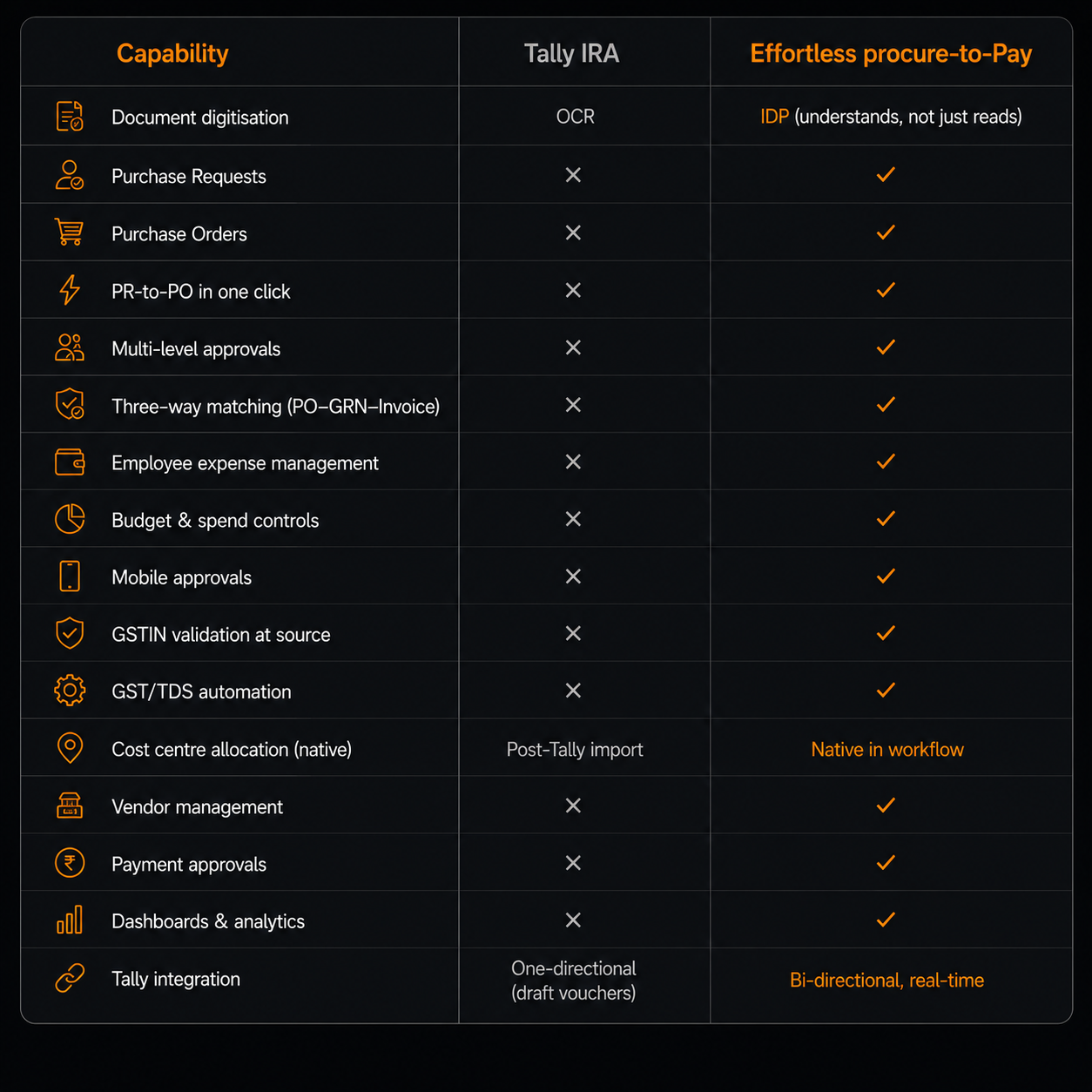
What TallyIRA does not do: raise or approve purchase requests; generate or track purchase orders; validate GRNs against POs; perform three-way matching; manage employee expense claims; enforce budget limits; support multi-level approval workflows; provide mobile approval interfaces; offer dashboards and analytics; or manage vendor onboarding with GSTIN validation at source.
It is also worth noting that TallyIRA's integration with Tally is one-directional: it creates draft vouchers. It does not pull existing Tally data back into its own workflows for analysis, reconciliation, or budget tracking. Effortless, by contrast, offers bi-directional Tally integration — data flows both ways, keeping your Tally books and your operational workflows in continuous sync.
The Effortless Procure-to-Pay Architecture
Effortless was designed around a different conviction: that Indian businesses don't just need faster data entry, they need end-to-end control over how money is committed and spent, with intelligence embedded at every step.
Here is how the full procure-to-pay lifecycle works inside Effortless:
1. Protect Sensitive Vendor Data
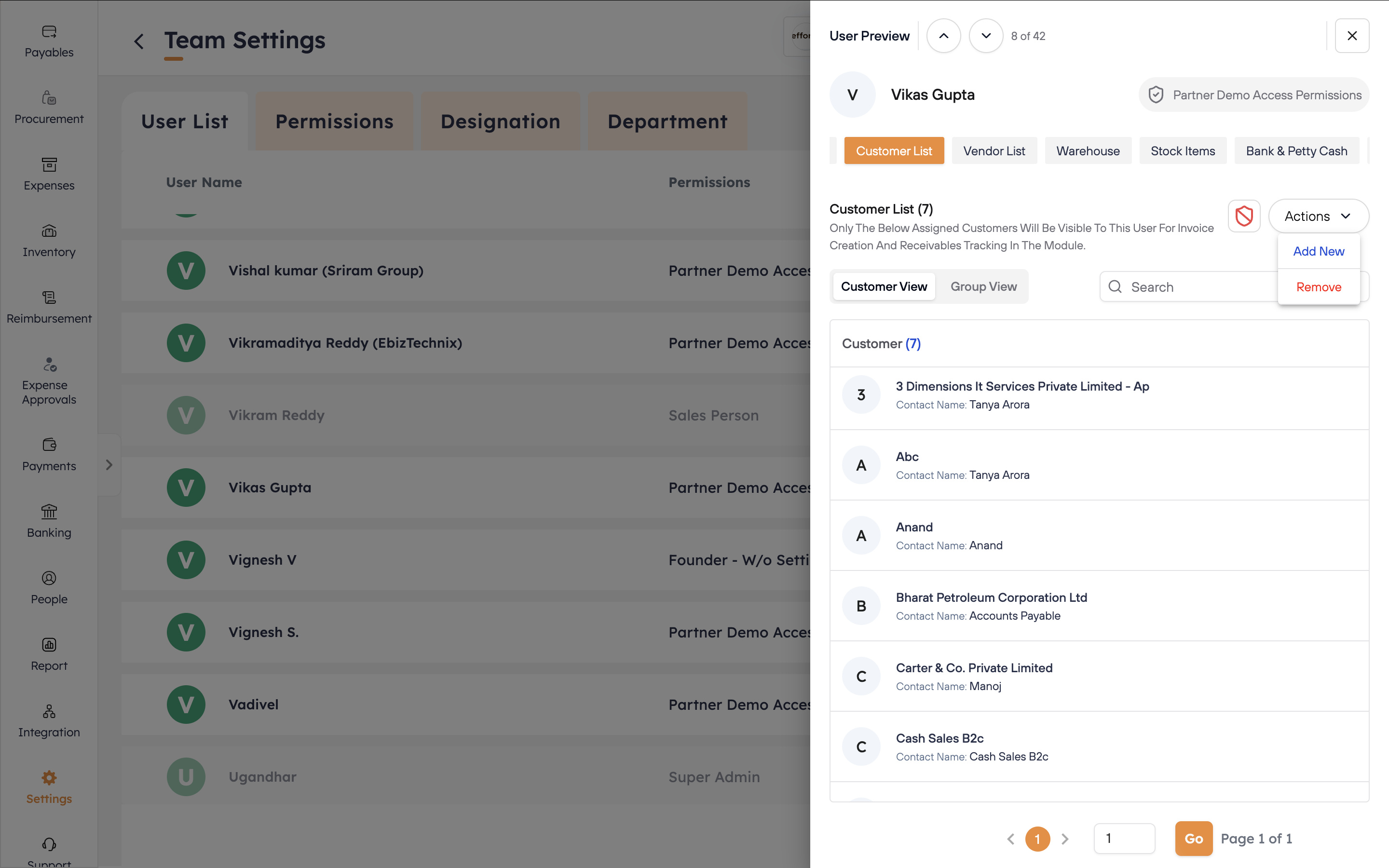
Vendor purchase data is a gold-mine. You take years to gain trust of your vendors and get the price or support you want. Protecting that data and information is highly critical. With Effortless, you assign specific Vendors/ product categories to your respective purchase rep. No Overlap - Protect sensitive purchase data.
2. Purchase Request (PR)
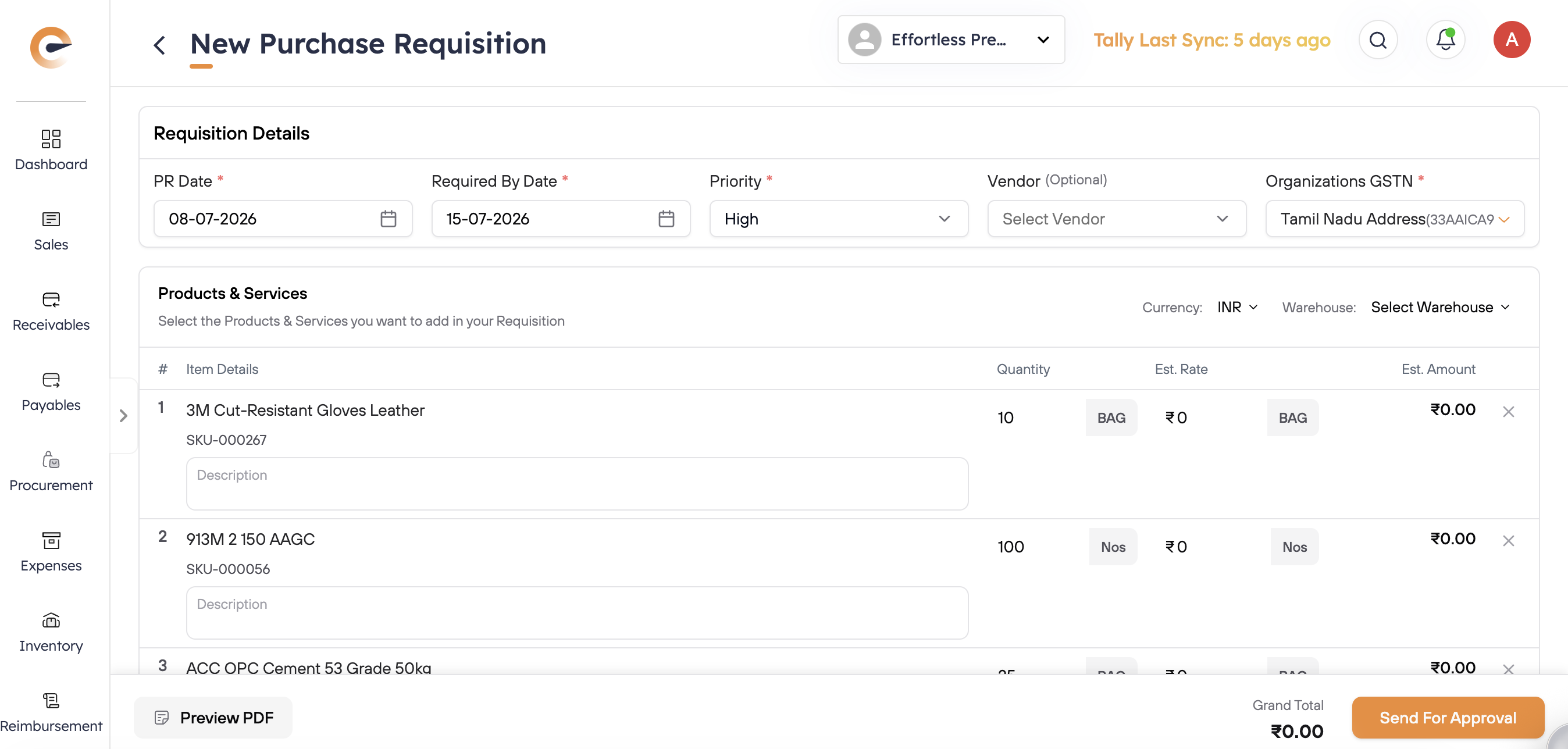
Everything begins with a formal, digital purchase request. Any employee can raise a PR from their Effortless login. The system enforces cost centre allocation natively — not by pushing data to Tally after the fact, but by capturing it at the point of origination. Budget controllers can see in real time how much of their approved budget has been committed versus spent.
3. Purchase Order Generation
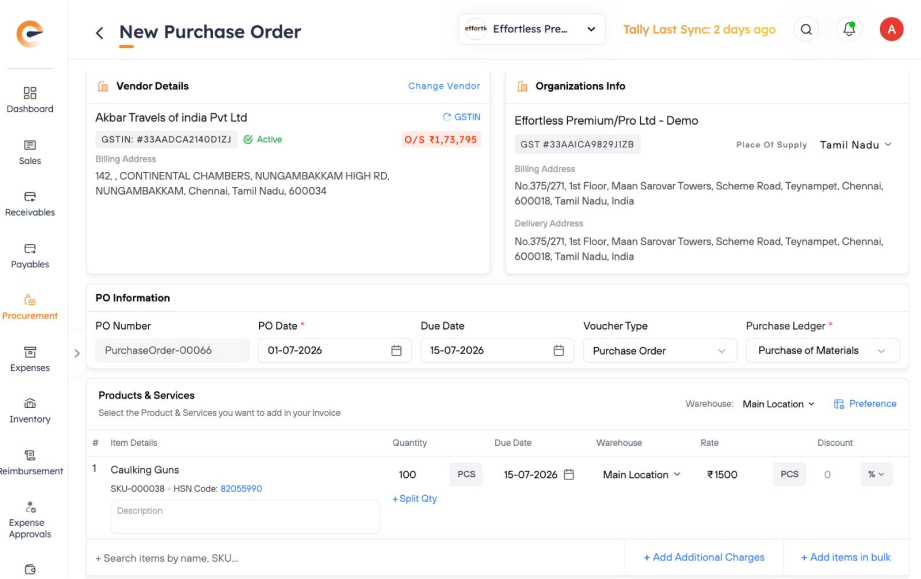
Approved PRs convert to POs in one click. PO formats are professional and GST-compliant. Vendors can receive POs via email or WhatsApp. All POs are tracked — open, partially received, fully received — giving procurement managers a live view of outstanding commitments.
4. GRN and Three-Way Matching
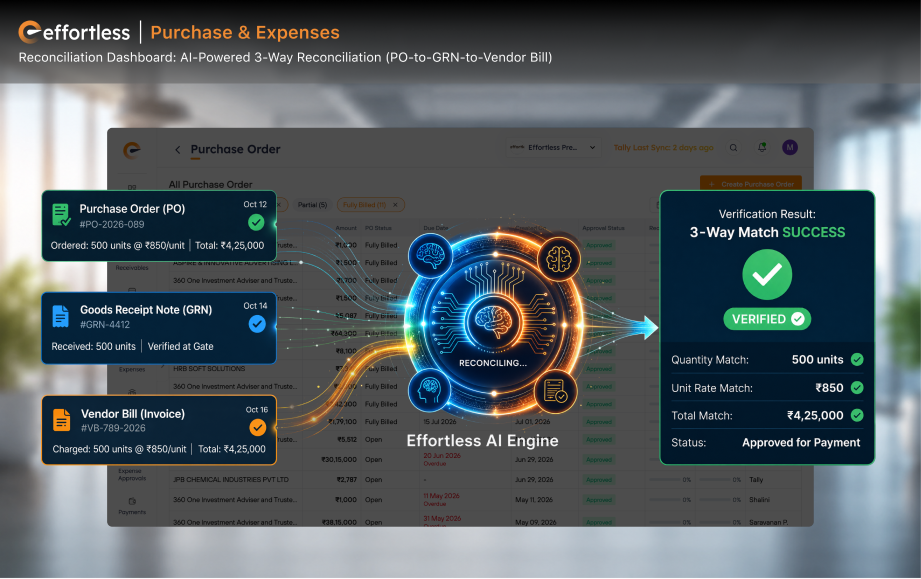
When goods arrive, the receiving team logs a Goods Received Note (GRN) against the open PO. Effortless then performs automated three-way matching: PO quantities and rates against GRN actuals against the vendor's invoice. Variances — short shipments, rate differences, unapproved line items — are flagged before the bill is approved for payment. This is the single capability that most directly recovers cash for mid-market businesses. Catching a 3% overbilling rate on ₹5 crore of annual purchases returns ₹15 lakh to working capital.

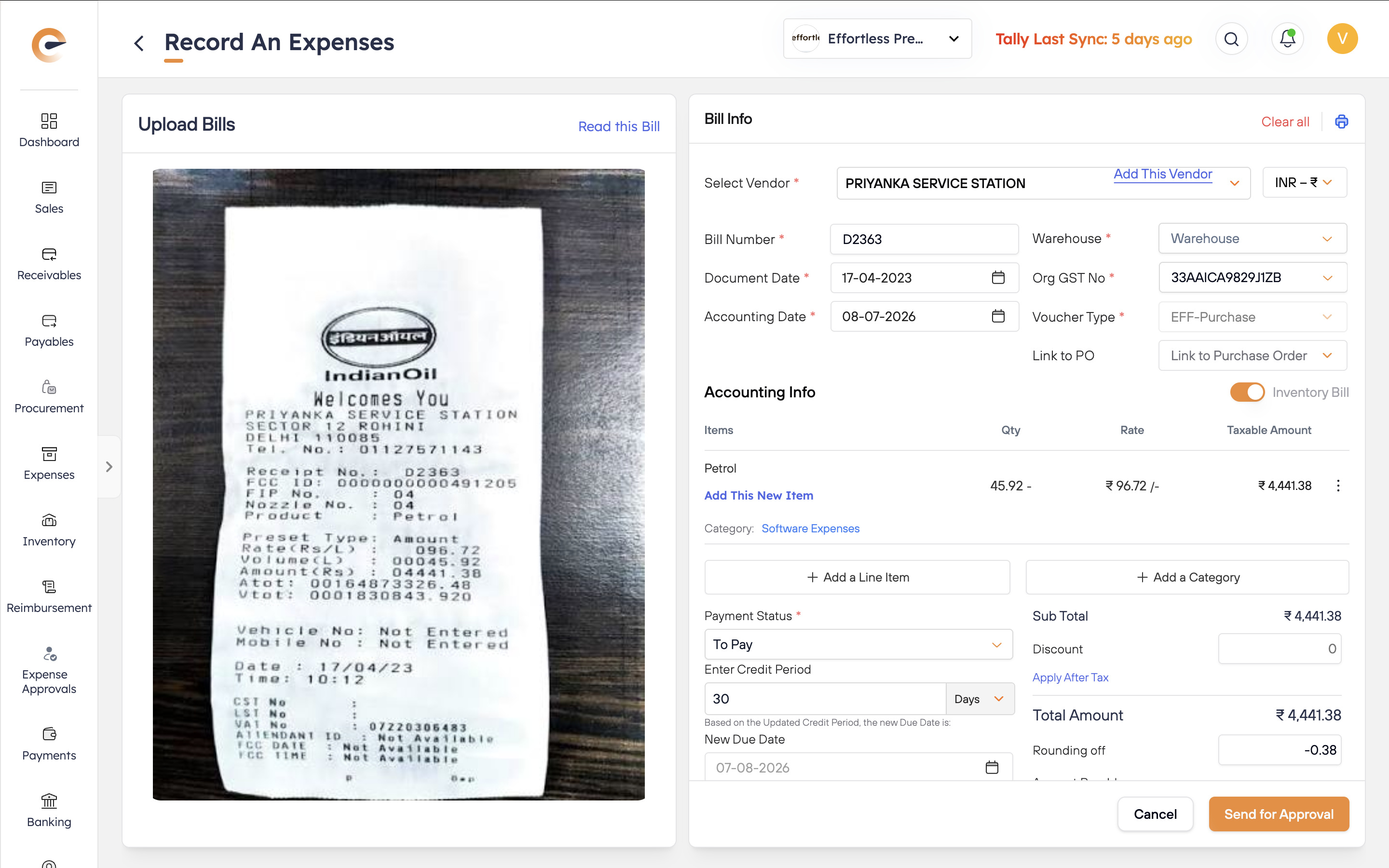
5. IDP-Powered Vendor Bill Booking
Unlike TallyIRA's OCR approach, Effortless uses Intelligent Document Processing (IDP). The difference is not semantic. OCR reads text from an image. IDP understands the document — it extracts structured data, classifies it, validates it against your existing master data (vendor GSTIN, agreed rates, contracted SKUs), and feeds it into your workflow. Bills can arrive via email, WhatsApp, or direct upload. IDP handles PDFs, images, and handwritten receipts. The result is not just faster data entry, but smarter data entry that catches errors OCR would simply transcribe.
6. Employee Expense Management
Effortless includes a complete employee expense claim and reimbursement module. Field staff submit claims with photo proof of bills from their mobile. Travel policy limits are enforced automatically — if your city-grade policy allows ₹2,000/night for accommodation in Tier 2 cities, claims above that are flagged without the finance team needing to remember the rule. GST/TDS automation ensures reimbursements are correctly classified. Multi-level amount-based approvals apply here too. For businesses with field sales teams, reimbursement processing is often a two-week cycle that demoralises reps and delays closings. Effortless brings it to 24–48 hours.
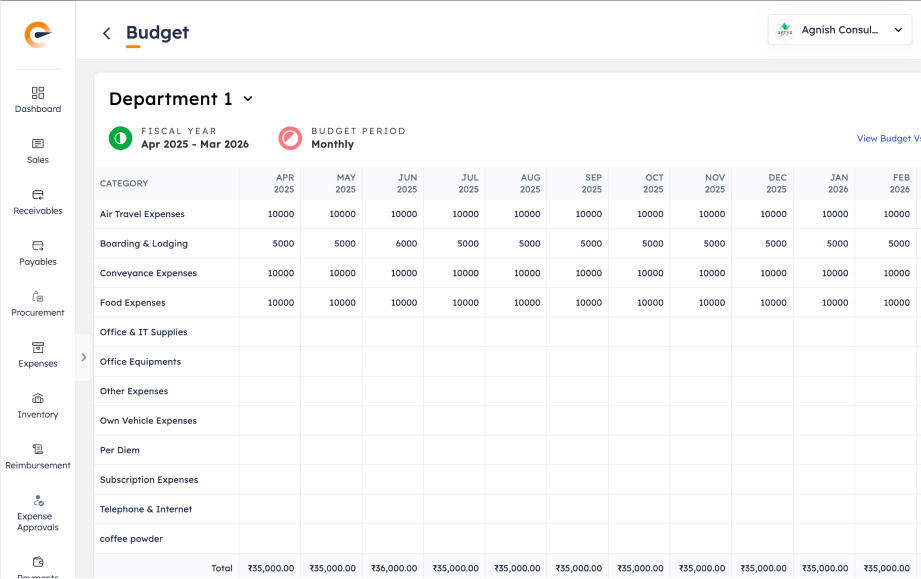
7. Budget and Spend Controls
Finance teams set budgets by cost centre, department, or project. As PRs are raised and POs are issued, the system tracks committed spend against budget in real time. Hard or soft blocks can be set — a soft block warns the approver that the budget is 90% consumed; a hard block prevents further commitments without finance override. This is the kind of spend control that mid-market companies typically only achieve with SAP or Oracle implementations costing ten times as much.
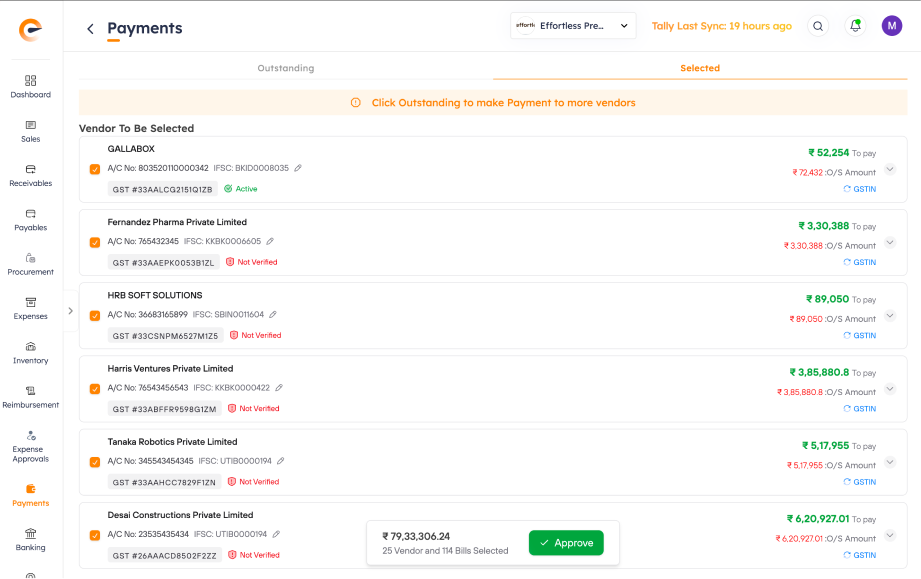
8. Payment Approvals and Settlements
Once a vendor bill passes three-way matching and the approval workflow, it proceeds to payment. Effortless supports bulk categorisation and invoice-wise settlement. Payment approval workflows are separate from purchase approval workflows — your CFO can approve the PO but your MD approves the payment, if that is your policy. Single window payment management covers vendor payments, customer advances, statutory payments, and internal advances in one interface.
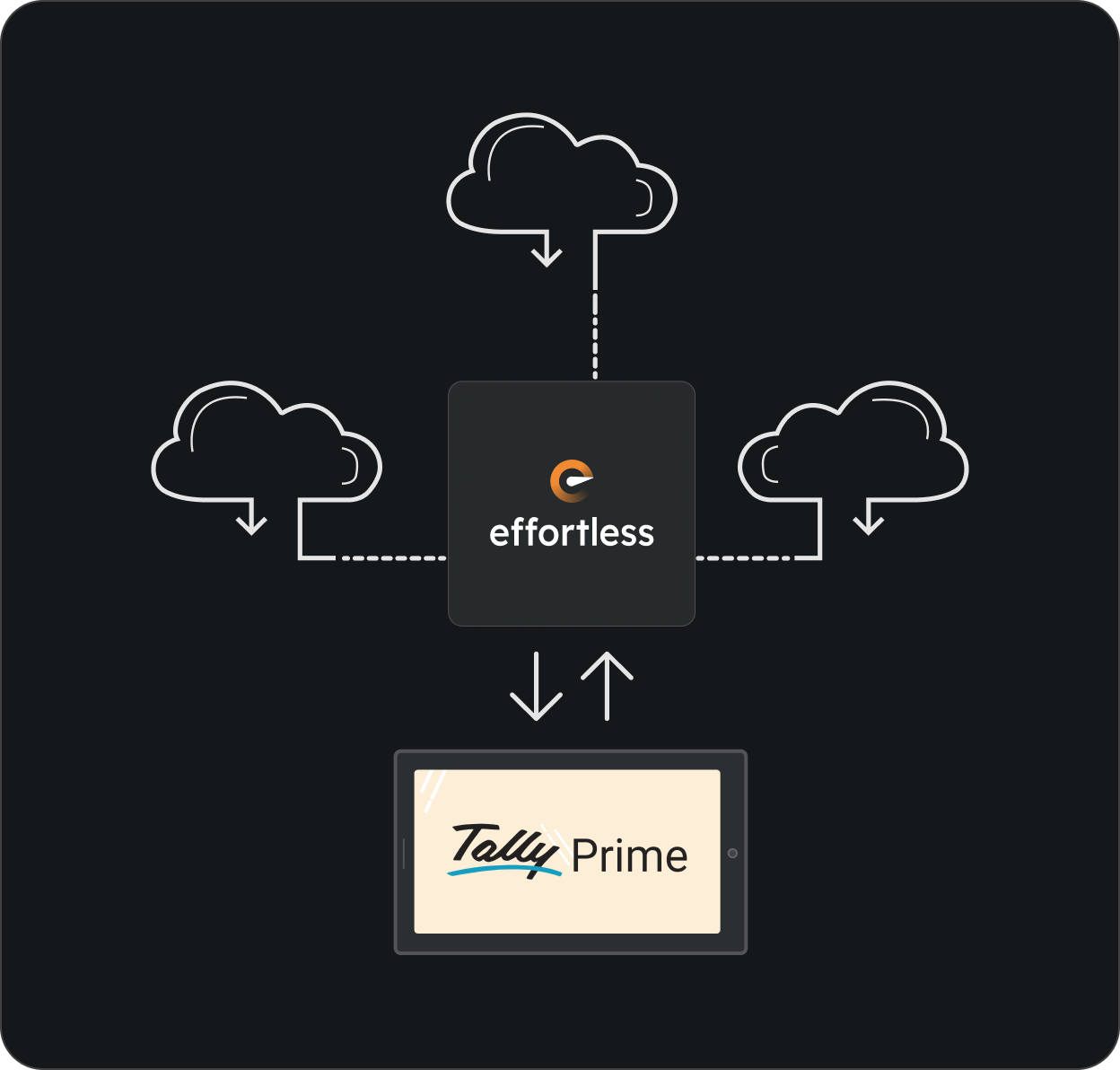
9. Bi-Directional Tally Sync
Everything — approved vouchers, cost centre allocations, vendor ledgers, payment entries — syncs to Tally in both directions. Your accountants continue to work in Tally. Your operations team works in Effortless. The two are always in sync. Multi-GSTN and multi-company concurrent sync is supported, which is essential for businesses operating across branches with separate GSTINs.
10. Dashboards and Analytics
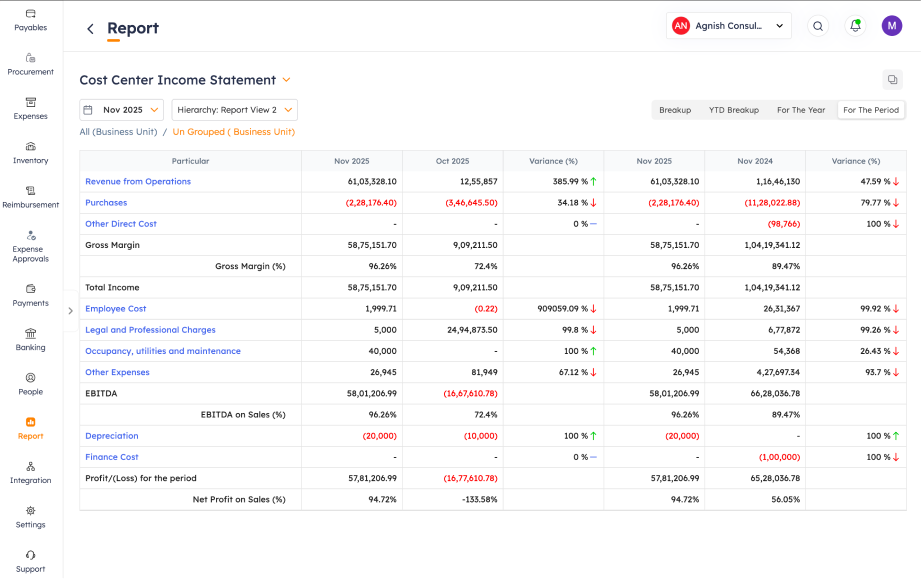
Finance leaders get a real-time view of procurement health: pending approvals, committed spend vs. budget, vendor-wise payables aging, ITC available vs. blocked, month-on-month purchase trends. Daily snapshots can be pushed to WhatsApp — the CFO and MD get a morning brief without opening a dashboard. For businesses whose procurement data has historically lived in a combination of Tally and WhatsApp groups, this is transformational visibility.
Who Should Use Which Tool
Tally IRA is right for you if: Your business is small (under ₹10 crore revenue), your purchase process is genuinely simple (you buy from a handful of regular vendors, there is no formal PO process, and overbilling is not a material risk), and your only pain point is the time your accountant spends keying in supplier bills.
Effortless Procure-to-Pay is right for you if: You have a team making purchases — formally or informally — and you need control over what gets committed before the bill arrives. If you have experienced overbilling, if your ITC claims have ever been questioned, if your month-end closing extends into weeks because reconciliation is manual, if you have field staff submitting expense claims that clog the finance team — Effortless is the architecture you need.
The practical threshold: if your business is doing more than ₹3–5 crore in annual purchases, the ROI on three-way matching alone typically pays for a full year of Effortless within the first quarter of implementation. That is before accounting for ITC recovery, faster month-end closing, or the management time saved by not chasing approvals via WhatsApp.
The Deeper Question: What Is Tally Integration Really For?
Indian businesses love Tally, and for good reason. It is reliable, CA-auditable, and deeply embedded in the compliance workflows of Indian accounting. The question is not whether to use Tally — it is what role Tally should play in your technology stack.
Tally is an excellent accounting and compliance system. It is not designed to be an operational procurement platform. The businesses that get the most out of Tally are those that use it as the accounting layer while running their operations — sales, purchase, expenses, approvals — through purpose-built operational tools that sync to Tally without friction.
This is exactly what Effortless is designed to be: the operational intelligence layer that sits in front of Tally, manages the complex human workflows (approvals, matching, expense claims, vendor management), and keeps Tally in sync bi-directionally. Your CA works in Tally. Your team works in Effortless. No double data entry. No reconciliation gaps.
TallyIRA adds an OCR lens to the last step of the process. Effortless restructures the entire process — and then syncs it to Tally.
Key Takeaways
Digitising a bill is not the same as managing a purchase. OCR/IDP at the point of invoice capture solves only the final step of the procurement process. The costly failures — unauthorised spend, overbilling, ITC leakage, budget overruns — happen upstream.
Three-way matching is the highest-ROI capability in procurement automation. For businesses doing ₹5 crore+ in annual purchases, catching even a 2% overbilling rate returns ₹10 lakh to working capital each year. Tally IRA has no three-way matching capability.
IDP is meaningfully better than OCR for procurement. OCR reads; IDP understands. The difference is whether the system catches a rate discrepancy between your PO and the vendor invoice, or simply transcribes the wrong rate into Tally.
Bi-directional Tally integration preserves your investment in Tally. You don't need to replace your accounting system. You need an operational layer that syncs to it in both directions — so Tally stays your source of financial truth while your team operates with real-time intelligence.
The ROI of Effortless is not "less typing." It is "less leakage." Budget control, ITC recovery, fraud prevention, faster closings, and vendor accountability are the value drivers. They are invisible in an OCR comparison and very visible in a P&L comparison.
FAQ
Q: We already use Tally Prime. Do we have to move away from it to use Effortless?
A. No. Effortless is designed to work alongside Tally, not replace it. Bi-directional Tally integration means your accountants keep working in Tally, and your operations team works in Effortless. Vouchers, ledgers, and cost centre allocations stay in sync automatically. This is a fundamentally different model from replacing your accounting system with an ERP.
Q: How is Effortless different from Zoho Books or other all-in-one ERP tools?
A. Zoho asks you to migrate your accounting out of Tally and into their platform — a high-disruption, high-cost change that many Indian businesses have attempted and reversed. Effortless keeps Tally as your accounting core and adds an AI-powered operational layer on top of it. There is no migration, no parallel accounting, and no disruption to your CA's workflow. For a detailed breakdown, see our post: Zoho ERP vs. Tally + Effortless: The All-in-One Trap Indian SMEs Must Avoid.
Q: What is the typical implementation timeline for Effortless Procure-to-Pay?
A. Most mid-market businesses are live within 2–3 weeks. Effortless onboarding is designed for zero disruption — your existing Tally data does not need to be migrated, and your team can begin using Effortless in parallel with existing processes from day one. See: Zero Disruption Tax: Why Effortless Onboarding Outperforms Traditional ERP Migrations.
Q: Can Effortless handle multi-branch and multi-GSTN setups?
A.Yes. Multi-GSTN compliance and multi-company concurrent Tally sync are core capabilities, not add-ons. Businesses operating across multiple branches — each with their own GSTIN — can manage procurement centrally while maintaining branch-level accounting separately in Tally.
Q: How does Effortless help with GST compliance and ITC recovery?
A.GSTIN validation happens at the point of vendor onboarding, so non-compliant vendors are flagged before any purchases are committed. GST/TDS automation ensures that expense categorisation and vendor bills are correctly handled. Three-way matching ensures that only genuinely received, correctly billed goods are approved for ITC claims. Together, these capabilities address the most common causes of ITC leakage in Indian mid-market businesses.
Q: What does Effortless cost compared to TallyIRA or a traditional ERP?
A.Effortless is priced for Indian mid-market businesses — not the enterprise brackets typical of SAP or Oracle. It is substantially more capable than a point solution like TallyIRA and substantially less expensive than a full ERP replacement. For current pricing, visit goeffortless.ai or request a demo.
Suggested Reading from The Effortless Edge
Catch Overbilling Automatically: Protecting Working Capital at the Source
Admin Overrides: Keep Approvals Moving When the Primary Approver Is Out
The Month-End Autopsy: Why Backdated Entries Are Destroying Your Audit Trail
Zoho ERP vs. Tally + Effortless: The All-in-One Trap Indian SMEs Must Avoid
Effortless is the AI-powered operations layer for India's fastest-growing businesses — built to work with Tally, not replace it. If your purchase process still lives in WhatsApp groups and spreadsheets, schedule a demo to see what a controlled procure-to-pay looks like.
Growth Doesn't Wait. Why Should You?
Let Effortless help you scale—without the scramble.
Talk to Us
Have questions about how Effortless can transform your business? Our team of experts is ready to help.
- Schedule a personalized demo
- Get your specific questions answered
- Discuss your unique business challenges
We'll reach out within 4 business hours
Request Demo
See Effortless in action with a personalized demo tailored to your business.
- No generic presentations
- Focus on your specific challenges
- Get a clear picture of your potential ROI
Choose a time that works for you
Your Growth Engine Starts Here
More growth, less overhead. Discover how India's fastest growing businesses do it.
- Automate invoicing, collections & approvals
- Track sales team performance
- Get cashflow clarity in real-time
Clarity in 30 minutes. No pressure, just proof.